GraphQL Load Testing: Queries, Mutations, and Expensive Resolver Paths
A practical GraphQL load-testing guide for query shape, resolver fan-out, variables, persisted operations, mutations, and useful failure criteria.
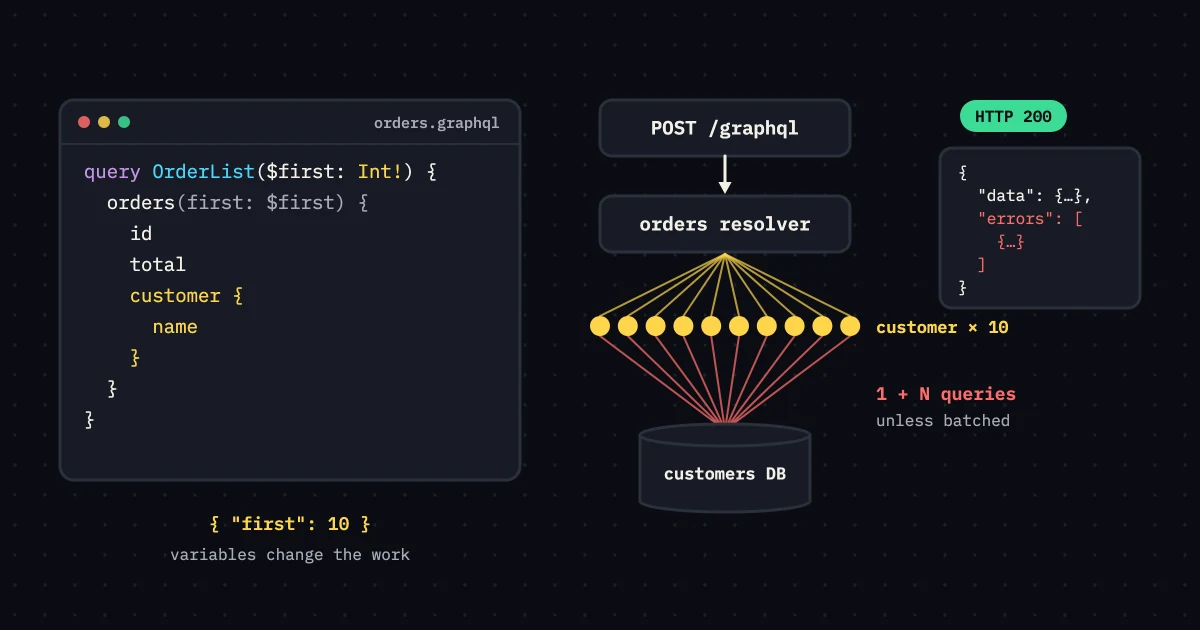
GraphQL load testing takes more than sending the same POST request over and over. The request envelope can stay constant while the work inside the server changes a lot. A shallow query may hit a cache and one resolver. A nested query may fan out across several services, serialize a large response and use up a database pool. A mutation adds validation, authorization and writes.
So ask “Which operation shapes stay correct and responsive under the load our clients create?” instead of “How many GraphQL requests can this endpoint handle?” This guide shows a way to answer it with scenarios that preserve query meaning, variables, dependencies, and failure signals.
Start with an operation inventory
List the named operations your clients actually use. Include the operation type, common variables, response size, authentication state, and downstream systems touched. A dashboard query, a search query, and a checkout mutation should not be collapsed into one generic GraphQL label. Their resource profiles and user impact differ.
For each operation, record a representative document and a small set of variable values. Include an ordinary case and an expensive-but-valid case. The latter is important: deeply nested relationships, broad filters, and large page sizes often reveal resolver behavior that a happy-path fixture never reaches. Keep test data safe and deterministic, but do not simplify away the relationship structure that production code must traverse.
Operation names become valuable labels in the result. If the client sends unnamed documents, add a stable scenario label in the test script. With labels, you compare latency, errors and throughput per operation, and a fast health query cannot hide a slow customer journey.
Measure query shape, not only request count
Requests per second is an input. It does not describe the work. A scenario should vary the dimensions that alter work:
- shallow versus nested selections;
- small and large page variables within an allowed range;
- cacheable reads versus deliberately uncached reads;
- one resolver result versus a list that invokes a resolver repeatedly;
- single mutations versus realistic mutation sequences.
Don’t invent impossible documents just to produce a large number. Test shapes that a schema permits and that a client could plausibly send. If query-cost analysis or depth limits are part of the server contract, test just below and just above those boundaries as separate correctness cases. A rejected operation is a useful result when the rejection is expected and clearly labelled.
The response body deserves assertions too. Check the GraphQL errors array, required data fields, and a small set of invariants. A transport-level 200 can contain an application-level failure. Successful HTTP averages are especially misleading for GraphQL because several field resolvers can fail while the envelope remains valid.
Expose resolver fan-out
Resolver fan-out is where a modest request count can become a serious dependency test. Instrument or observe calls to databases, caches, queues, and internal APIs during a representative run. Compare a query that asks for ten parent records with one that asks for one. If downstream calls grow linearly or worse, the test should make that relationship visible.
You are diagnosing, not hunting for a universal “number of resolvers” threshold. A batched data loader may turn many field requests into one efficient call. A missing batch boundary may do the opposite. Look for pool wait, query count, lock time, downstream latency, and response serialization together. A GraphQL p95 that rises alongside database pool wait points to a different action from a p95 that rises with response size and network transfer.
Repeat the scenario with caching conditions stated explicitly. Warm-cache and cold-cache runs answer different questions. Do not compare them as though they were the same workload, and do not call a cold-cache result a regression unless the baseline has the same cache state.
Treat variables as part of the contract
Variables are inputs. Treat them with the same care as the query. Use realistic identifiers, filters, pagination cursors, and feature flags. If one request produces a cursor needed by the next request, extract it from the response and validate it before reuse. A constant cursor can make a multi-step test look stable while exercising one record forever.
Keep variable generation bounded and explainable. Random values are useful for breadth, but uncontrolled randomness makes a failure difficult to reproduce. Seeded data sets, rotating fixtures, and named cases offer a middle ground. Record which case produced an error so a developer can replay the same operation shape.
The correlation guide is useful when tokens, IDs, or cursors cross request boundaries. For GraphQL, this often means carrying a created object ID from a mutation into a query, then checking that the queried object is the one created by the virtual user.
Give mutations their own lane
Give reads and writes separate success criteria. A mutation can return quickly while an asynchronous side effect is lost, duplicated, or delayed. Assert the immediate response and, where the product contract permits, verify the observable result through a follow-up query or an independent signal. Avoid turning the test into a full end-to-end business audit if the purpose is resolver capacity; choose a small invariant that proves the write was accepted correctly.
Protect the target with test-specific data and cleanup rules. Idempotency keys, unique fixture namespaces, and bounded object creation help prevent a load run from becoming an uncontrolled data migration. If cleanup itself is expensive, measure it separately instead of hiding its work in the scenario duration.
Choose decisions before running
Write the failure criteria in operation terms: no unexpected GraphQL errors, no invalid response invariants, p95 for a named query below its agreed budget, and no unacceptable downstream saturation. Keep the criteria tied to the scenario’s purpose. A broad exploratory run can produce observations without blocking a release. A release gate needs stable, explicit thresholds. The API gate pattern describes how to keep those decisions reviewable.
Finally, compare like with like. Pin the schema version, fixture set, query documents, variable distributions, environment shape, and cache state. Store the operation labels with the result. When a query changes, treat the change as a new workload until its relationship to the old shape is understood.
A review checklist for each operation
Use an operation matrix to plan a deliberately uneven mix instead of giving every operation equal weight. A common dashboard query may deserve frequent traffic, while a costly export may need a lower proportion but a separate guardrail. Record those choices beside the scenario so a reviewer can tell whether a failure comes from volume, shape, or an assertion. For persisted operations, keep the identifier and check that the server resolves the intended document. Arbitrary query text does not test the persisted-query path. For mutations, include idempotency and cleanup behavior that protects the fixture. For authorization cases, keep expected denial separate from genuine transport failures. At the end of a run, compare the observed operation mix with the requested mix. A test can look healthy and still answer the wrong question if one fast operation dominates because another was rejected during setup.
Before sharing a scenario, check that another engineer can identify its operation name, variables, fixture assumptions, expected errors, and downstream work. Confirm that pagination does not silently return the same page, that authorization is exercised for the intended actor, and that a large response is bounded by a deliberate limit. Check that the test’s labels survive aggregation and that a failed field assertion is visible without opening raw response bodies. These small checks keep the scenario useful as the schema evolves, and stop a passing transport metric from becoming the only record of behavior.